
In this guide
PFAS, lead and fluoride are three of the most-searched water worries in Ontario, and they have one thing in common: a regular filter jug or a water softener won't reliably remove them. Here's what each one is, how much Canada allows, and which home systems actually take them out.
The short answer
- Reverse osmosis (RO) reduces all three: PFAS, lead and fluoride.
- Activated carbon reduces PFAS and lead, but not fluoride.
- Water softeners don't remove any of the three. They take out hardness (calcium and magnesium).
- Boiling doesn't remove them either.
For drinking and cooking water, an under-sink reverse osmosis system is the one option that covers all three.
What are PFAS (forever chemicals)?
PFAS (per- and polyfluoroalkyl substances) are a family of thousands of man-made chemicals used in non-stick pans, stain- and water-repellent fabrics, food packaging and firefighting foam. They're called forever chemicals because they barely break down, so they build up in soil, water and the body.
In August 2024, Health Canada set a drinking water objective of 30 nanograms per litre (ng/L) for the total of 25 specific PFAS, one of the strictest limits in the world. Ontario had used an interim guidance value of 70 ng/L for 11 PFAS since 2017.
The good news: Ontario's monitoring shows levels in treated municipal water are generally below the Health Canada objective, including Lake Ontario, which supplies most of Durham Region and the GTA. The risk is higher for private wells near airports, firefighting training sites, landfills and some industrial sites.
Lead: the problem is usually your pipes
Health Canada's limit for lead is 0.005 mg/L (5 micrograms per litre), lowered from 0.01 mg/L in 2019. There's no known safe level of lead, so the goal is as low as possible, especially for babies, children and pregnant women.
Lead rarely comes from the treatment plant. It leaches from lead service lines, older solder and some brass fittings inside the home. Canada's plumbing code allowed lead pipes until 1975, so older homes are the ones to check. Water that has sat in the pipes overnight usually has the most.
Fluoride: added on purpose in much of Durham Region
Fluoride is added to municipal water in Ajax, Brooklin, Courtice, Oshawa, Pickering and Whitby to help prevent tooth decay, at about 0.5 to 0.8 mg/L. Health Canada's maximum is 1.5 mg/L and its optimal level for dental health is 0.7 mg/L. Some wells have higher natural fluoride.
Whether to remove it is a personal choice. If you'd rather not drink fluoridated water, reverse osmosis is the practical way to take it out at home.
Which filter removes what?
Reverse osmosis
RO pushes water through a membrane fine enough to stop dissolved contaminants, with carbon stages before and after. It reduces PFAS, lead, fluoride, chlorine taste and total dissolved solids. It's installed under the kitchen sink for drinking and cooking water. Compare our Standard RO (2, 4 or 5 stage) and the tankless Big Flow RO.
Activated carbon
Carbon traps PFAS and lead as water passes through, and removes chlorine and chloramine taste. It works at a single tap or for the whole home, like our ClearBlu Plus. It doesn't remove fluoride, and it works only while the cartridge is fresh, so replacements matter.
Water softeners
A water softener solves hard water: scale, spots and dry skin. It isn't designed to remove PFAS, lead or fluoride. Many homes pair a softener for the whole house with RO at the kitchen sink.
How to choose a system that really works
- Test first. A free in-home water test shows what's actually in your water.
- Look for the right certification. Health Canada advises systems certified to NSF/ANSI 53 (carbon) or NSF/ANSI 58 (RO), with a specific claim for PFAS or lead reduction. Ask for the certification listing of the exact model.
- Change filters on schedule. A spent carbon cartridge stops protecting you.
- On a private well, test for PFAS with an accredited lab if you live near an airport, landfill or industrial site.
Not sure what's in your water?
We test your water at home, explain the results in plain language, and recommend only what your water needs. Book a free water test.
Questions
Does reverse osmosis remove PFAS?
Yes. Reverse osmosis is one of the most effective home treatments for PFAS, along with activated carbon. Look for a system certified to NSF/ANSI 58 with a PFAS reduction claim.
Does a water softener remove lead or PFAS?
No. A water softener removes hardness minerals. For lead and PFAS you need reverse osmosis or a certified activated carbon filter.
Does boiling water remove lead, PFAS or fluoride?
No. Boiling doesn't remove any of them, and as water evaporates it can slightly concentrate what's left.
What is the limit for PFAS in Canadian drinking water?
Health Canada's 2024 objective is 30 ng/L for the total of 25 specific PFAS.
Is there fluoride in Durham Region tap water?
Yes, in Ajax, Brooklin, Courtice, Oshawa, Pickering and Whitby, where it is added at about 0.5 to 0.8 mg/L. Reverse osmosis removes most of it.
Systems mentioned in this guide

Standard RO
2, 4 or 5-stage drinking water systems, with a bonus alkaline cartridge on the 5-stage.
See Standard RO
Big Flow RO
Tankless 400 GPD reverse osmosis with a 1:1 waste ratio for bigger households.
See Big Flow RO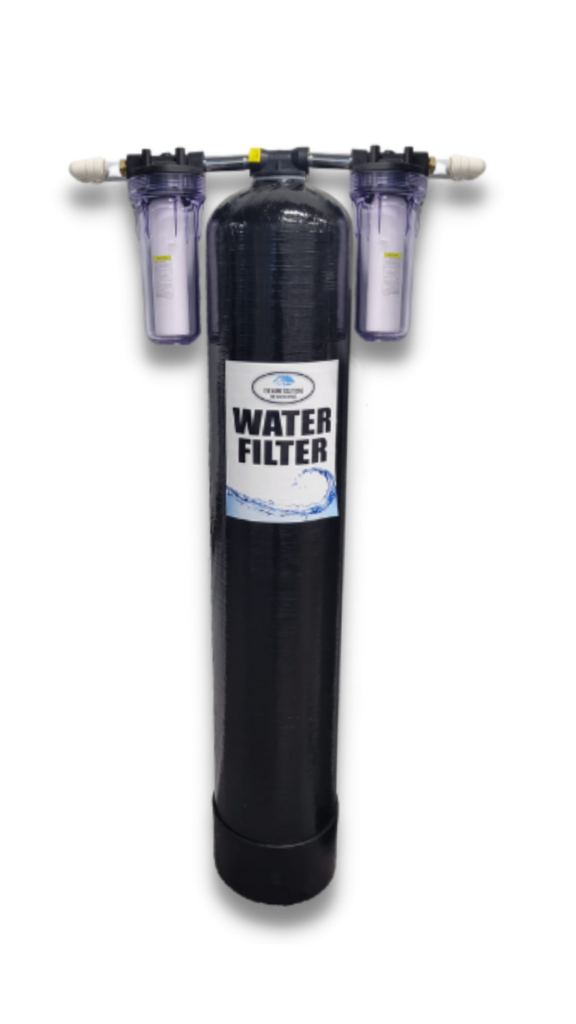
ClearBlu Plus
Filters every tap and shower: chlorine, chloramine, sediment, taste and odour.
See ClearBlu Plus